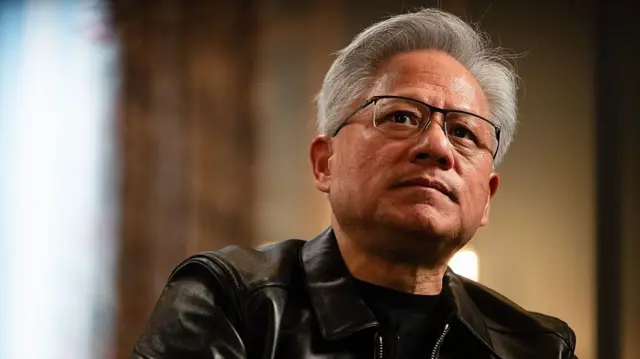
Cointime reports: NVIDIA’s recent leadership reversal is one of the most dramatic events in tech and capital markets lately. When Jensen Huang returned as CEO, global markets reacted instantly and strongly: the stock surged and trillion-dollar market cap fluctuated. Media outlets will recount the full story, but the founder of Pomp Investments distilled nine core judgments worth pondering from an investment and industry perspective.
For the tech industry, Huang’s return is enough to place him among legendary founders. Completing such a comeback at a company he founded and that has operated for thirty years—and swaying trillions in market cap the moment the news landed—is rare in tech business history. As a recognized central figure in AI, the market is willing to pay a premium for his leadership; this is not incidental hype but a concentrated expression of long-term consensus on the compute track.
This episode also plainly proves that shareholders’ voices carry strong weight. The board’s earlier push for Huang to step down directly triggered a market selloff; after his return, the stock rebounded sharply. Behind the rise and fall is investors’ clear vote: the market believes only Huang is the most suitable helmsman for NVIDIA, and the board’s prior intervention went against most shareholders’ expectations.
In the author’s view, the current board itself has become a risk for NVIDIA. These directors pushed the founder out of the company he built, exposing trillions in shareholder value to risk. Trust, once broken, is hard to repair; the board’s stance has diverged from the company’s core interests. To stabilize long-term development, restructuring the board and replacing members is a necessary choice.
On the trading front, the AI compute mainline story is not over. The short-term pullback is just a brief breather; the underlying logic is unchanged, and global compute remains in short supply. Huang’s return will act as a catalyst for a new AI rally, and the AI trade may see a second wave of gains.
More noteworthy is the power shift behind the event. Reports suggest that senior White House officials were deeply involved in communications with NVIDIA’s board, pushing it to agree to Huang’s reinstatement. This may be a landmark case of the U.S. government directly intervening in executive appointments at a major tech company. From this point on, NVIDIA is no longer just a commercial company; it will bear the imprint of U.S. macro strategy and be indirectly constrained by U.S. policy.
In terms of public opinion, the internet is almost universally cheering Huang’s return, though some market participants offer an obscure comparison: before Enron collapsed, its CEO Ken Lay also returned. But the author argues this analogy has no reference value; there is no evidence of financial fraud at NVIDIA, and a more reasonable inference is that the U.S. government provided a risk backstop, dispelling market concerns about compliance.
This episode also exposes the declining influence of mainstream media. For some time, many media outlets continuously produced negative reports about Huang, with related rumors and allegations appearing in turn, but these narratives ultimately failed to sway the market’s judgment. In the face of hard industrial value, the power of public opinion smears has failed; the market only believes in the company’s own value and the founder’s capabilities.
In the chip geopolitical game, there lies a long-term dilemma for the U.S. From the U.S. perspective, continuing to supply mature chips domestically is the strategy more aligned with short-term interests. If supply is continuously tightened, it will only force the domestic chip industry to accelerate self-development; once domestic chips surpass in performance, it will completely rewrite the global compute landscape—a long-term risk the U.S. does not want to see. Supplying chips is essentially a gambit to maintain technological dependence and delay rivals’ breakthroughs.
Finally, this episode also points to the route battle in the AI race. Leading closed-source AI companies do not want the open-source ecosystem to grow, as open source dilutes their technological barriers. This is precisely NVIDIA’s opportunity: Huang can leverage its compute advantage to invest heavily in U.S. domestic open-source AI, using the open-source ecosystem to challenge closed-source giants and reshape the competitive landscape of the entire AI industry.
In summary, Huang’s return is never just a simple personnel change. It intertwines capital games, U.S. government intervention, global chip competition, and the confrontation between open-source and closed-source AI routes. It is a highly symbolic event in the AI era, and its aftermath will continue to reverberate in the compute market and geopolitical tech competition.