OKXICE Faces Issuer Pushback: Why 56 of 62 Companies Rejected Tokenized Stock Listing
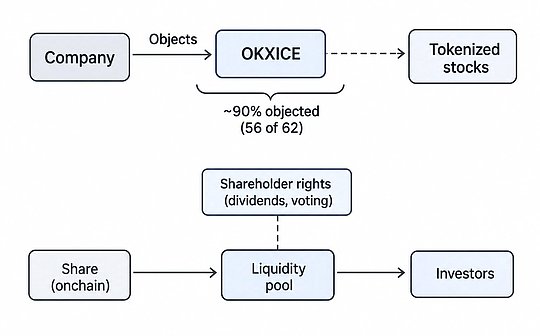
Cointime reports: OKXICE, a new tokenized stock platform backed by OKX and the parent company of the New York Stock Exchange, has encountered significant resistance from the very companies it hoped to feature. As of November 5, 56 of the 62 companies initially selected for listing had raised objections—roughly 90%. The list includes tech giants like Apple, Nvidia, and Microsoft, which declined to have their shares traded on the platform.
But the rejection raises a critical question: investors can already access tokenized versions of these stocks through products like xStocks and Ondo. So what exactly are these companies objecting to?
The Difference Between Existing Tokenized Stocks and OKXICE
Most tokenized stocks in the market today are issued by third parties, not by the companies themselves. For example, each xStock token is backed by a real share held in custody, but the token is a financial instrument that provides economic exposure only—holders do not enjoy direct shareholder rights such as voting. Apple does not participate in the creation of AAPLx; the token simply tracks its stock price. Under the relevant product structures and jurisdictions, companies are not required to endorse such instruments.
OKXICE, however, is attempting a different approach. In September, the U.S. SEC introduced a new framework allowing eligible platforms to trade tokenized U.S. stocks through on-chain liquidity pools. Unlike many existing stock-linked tokens, these instruments must preserve traditional shareholder rights, including dividends, voting rights, and residual ownership. The framework also gives companies a 30-day window to object when a non-affiliated third party seeks to offer their tokenized shares on a specific trading venue.
OKXICE proposed to list shares of 62 companies. Most objected. These objections block trading on OKXICE under the exemption but do not automatically affect existing stock-linked tokens on other platforms.
Why Are Companies Objecting?
Most companies have not publicly explained their decisions. JPMorgan, which also objected, said it remains interested in tokenization but is cautious about how its shares are represented and traded. The SEC itself has listed several potential concerns, including shareholder record management and price discrepancies between on-chain liquidity pools and traditional stock markets.
Consider what OKXICE is proposing: stocks traded via automated liquidity pools using stablecoins, potentially outside regular U.S. trading hours. This raises new questions about price discovery, liquidity fragmentation, and how shareholder rights are exercised. For issuers, the direct financial benefit is not immediately obvious.
The Six Companies That Did Not Object
Among the original 62, only Coinbase, Robinhood, Circle, Strategy, Securitize, and BitGo had not publicly objected as of November 5. Each is connected to the crypto industry. This does not mean all six formally support OKXICE, but they already operate in markets where on-chain assets, wallets, and digital settlement are highly relevant to their businesses. For traditional companies, the incentive to support an unfamiliar trading structure may be low until it is tested.
Tokenization Advances on Other Fronts
On October 28, DTCC launched tokenization services for securities within its existing custody infrastructure. Other projects are exploring issuer-led models where companies and their transfer agents directly participate in maintaining ownership records. These paths touch different market segments than OKXICE. There is no single structure for tokenized stocks; legal rights, infrastructure, and participants can vary widely—and this is becoming increasingly important as the market evolves.
What This Means
Tokenized stock products already exist. The technology works, and investors can gain on-chain exposure to major U.S. equities. But integrating true shareholder rights and new trading venues requires more coordination. Platforms want volume and distribution, investors want access and liquidity, and companies need a reason to support the structure and confidence in how their shares will trade. The objections to OKXICE show that regulatory permission alone is not enough to guarantee issuer participation. The next challenge for tokenized stocks may lie more in getting companies themselves on board than in blockchain technology.