The $100 Billion Reflexivity Trap
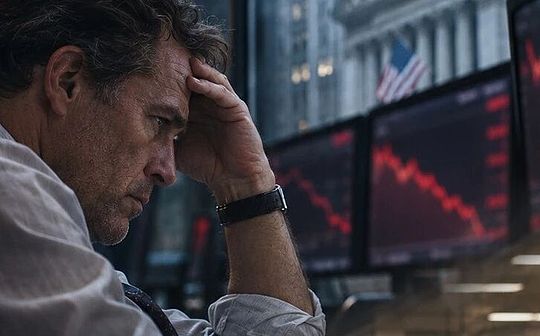
Cointime reports: On Thursday, a massive wave of mechanical selling orders—estimated at over $100 billion—hit the US stock market, triggering a cascade that wiped out $2.3 trillion in market value. But the trigger wasn’t just the political shock of a Democratic sweep in the midterm elections. It was the market’s own cleverness.
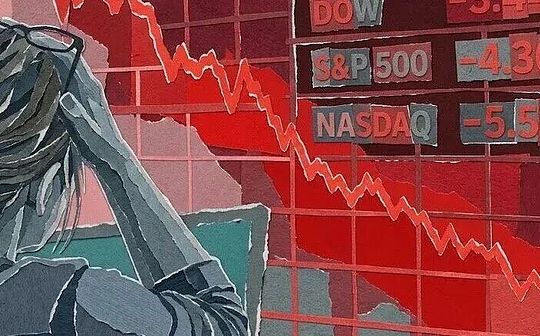
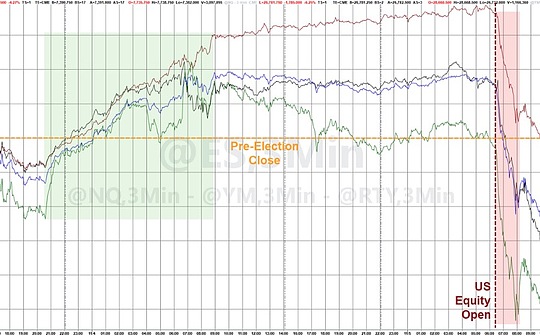
The Nasdaq 100 plunged 6.4%, its worst day since March 2020. The S&P 500 fell 4.4%, and the Philadelphia Semiconductor Index crashed 12%. The VIX spiked 70%.
The Anatomy of a Stampede
The day began with a political shock: a “blue wave” raised fears that 45% of planned US data center expansion could face moratoriums, undermining the AI narrative that has powered tech valuations.
But the real accelerant was a self-inflicted wound. By midday, Morgan Stanley’s derivatives team had calculated that leveraged ETFs would need to sell $52 billion before the close to rebalance. Word spread across Wall Street in minutes.
Traders, knowing the mechanical selling was coming, rushed to front-run it: sell now, buy back lower at the expected 2-3 PM dip. This strategy had worked repeatedly in recent weeks.
But this time, the reflexivity trap snapped shut. With everyone selling ahead of the expected dip, the dip never came. The cavalry—the buyers who were supposed to step in—was already the one selling.
Nomura’s Charlie McElligott warned of this exact scenario: “If the ‘assumed 2-3 PM low then rally’ doesn’t materialize, the front-runners themselves become the selling force.”
The Mechanical Selling Isn’t Over
Total mechanical selling exceeded $100 billion, including $47 billion from leveraged ETFs, $61 billion from volatility-control funds, and dealer negative gamma flows. And it’s not done: vol-control funds lag by 1-2 days, so Friday will see more forced selling.
Asia answered the question on Friday: South Korea’s KOSPI plunged 8.8%, triggering a circuit breaker, while Japan’s Nikkei fell nearly 5.8%, entering a technical bear market.
The bond market also saw a squeeze: CTA trend funds, heavily short bonds, faced a massive short squeeze as flight-to-safety buying pushed yields down. McElligott estimates a 2% further rise in bond prices could trigger $225 billion in forced global bond buying.
What’s Next?
The “best trade of the year”—long semiconductors and energy—was wiped out in 48 hours, with both legs collapsing simultaneously. Walleye Capital returned client money and fired its equities head, calling it the worst month since COVID.
Friday’s nonfarm payrolls report is the next catalyst. A weak number could force the Fed’s hand and provide a floor; a strong number could accelerate the selloff.
For crypto markets, the reflexivity lesson is clear: when everyone knows the same playbook, the playbook fails. In a world of leveraged ETFs, vol-control funds, and algorithmic trading, mechanical flows can overwhelm fundamentals—and the smartest money can become the stampede.