A Market Fractured: The Worst November Since 2008
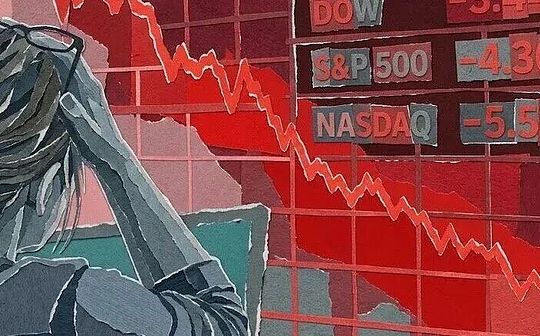
Cointime reports: On November 5, US equities suffered their sharpest one-day decline since the pandemic panic of March 2020. The Dow Jones Industrial Average plunged 1,833 points (3.44%), the S&P 500 dropped 4.36%, and the Nasdaq Composite fell 5.52%, erasing roughly $3 trillion in market value. The VIX volatility index spiked above 28. But this selloff was not uniform—it was deeply split. While AI-linked stocks and hedge funds imploded, Berkshire Hathaway hit an all-time high and Walmart surged. This divergence signals a deeper structural shift: the AI boom is creating a K-shaped economy that could persist for a decade.
The Stampede: Hedge Funds Flee
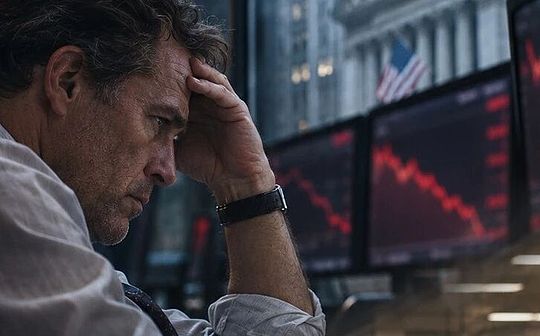
Goldman Sachs’ prime brokerage data reveals that hedge funds have been net sellers of US stocks for six consecutive weeks, with the last two trading days seeing the largest selling volume on record. Trend-following CTAs may offload another $40 billion in the coming week, with total selling pressure potentially reaching $65 billion. Tech stocks have been hit hardest—semiconductors in particular—yet they still account for 23.5% of prime brokerage books, near the 90th percentile of the past five years. The unwind is far from over. High-profile casualties include Walleye Capital (down 5.9% in October), Millennium (redeeming $1.5 billion), and Lone Pine (facing liquidation risk). One trader summed it up: “The tape looks like a liquidation.”
The Trigger: Political Shift and Data Center Bans
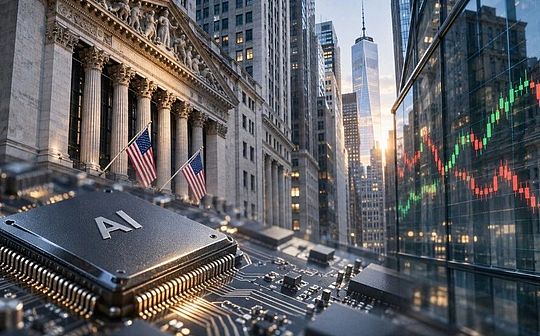
The midterm elections on November 3 handed Democrats control of both chambers, and their hostility toward AI infrastructure is deeper than markets anticipated. Senator Sanders called for a national moratorium on data centers. Newly elected Democratic governors in Texas, Georgia, Ohio, and Nevada have pledged to pause data center approvals. Goldman notes that 45% of US data center capacity under construction or planned is located in these states. This effectively severs the investment chain—AI needs compute, compute needs data centers, data centers need capex—that has powered the market for two years.
Musk: The Biggest Loser
Elon Musk bore the brunt of the selloff. Tesla fell 11% on November 5, SpaceX dropped 9% below its IPO price, and Musk’s net worth shrank by $74 billion in a single day. His $366 million in political donations to Republican candidates yielded little as Democrats swept the elections. The looming data center bans directly threaten Tesla’s AI and autonomous driving narrative, as well as SpaceX’s planned orbital data centers. Musk even deleted a pro-Republican post on X—a rare retreat.
Berkshire and Walmart: The Other Side of the Split
As tech bled, the other side celebrated. Berkshire Hathaway’s A-shares hit a record $821,931, buoyed by its $365 billion cash pile—now seen as the ultimate “anti-AI trade.” Walmart rose 5.6% on the crash day and is up 13.9% in October, its best month since 2014. The reason: consumers are trading down. High-income households are shifting from Whole Foods to Walmart, signaling a K-shaped consumer economy.
The K-Shaped Economy: A Structural Divide
Oxford Economics data shows AI has boosted household wealth by over 7%, but the gains are highly concentrated. In Q1 2026, AI-related economies grew 31% while non-AI economies grew just 0.1%. Societe Generale notes that AI returns accrue to three groups: those who own compute, data, and models. For everyone else, AI is a cost, not an opportunity. BlackRock’s Larry Fink has warned that AI could exacerbate inequality. Oxford predicts the K-shaped divergence could last until 2035.
The market’s split on November 5 reflects this reality: AI stocks sold off because policy may block growth and because that growth hasn’t broadly benefited the economy. Defensive consumer stocks rose because people still need to eat—and increasingly can only afford cheaper options. Berkshire and Walmart’s gains are not a sign of optimism; they are a warning. Smart money is pricing a world where AI doesn’t save everyone.
Forward Outlook
Investors should brace for continued volatility as political risks to AI infrastructure mount. The K-shaped economy favors defensive value stocks and cash-rich conglomerates over high-growth tech. Crypto markets, closely correlated with tech equities, may face similar pressures—particularly AI-themed tokens and data center-linked projects. The structural divide is likely to deepen, making diversification and risk management paramount.