2027 Compliance Calendar: Four Regulatory Peaks Reshape Global Crypto and AML Rules
Cointime reports: A comprehensive review of official regulatory calendars has identified 62 confirmed compliance deadlines for 2027, with four distinct peak periods that will significantly impact multinational corporations and financial institutions, particularly in the cryptocurrency and digital asset space.
News Summary
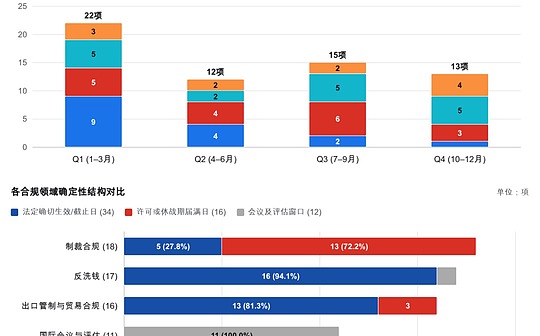
The 2027 calendar features 22 deadlines in Q1 alone, representing 35.5% of the annual total. Key dates include the US GENIUS Act taking effect on January 18, which brings payment stablecoin issuers under the Bank Secrecy Act and requires technical capabilities to execute lawful freeze orders. The EU’s Anti-Money Laundering Regulation (AMLR) will directly apply across all 27 member states on July 10, ending fragmented national rules. September 30 emerges as a critical convergence point with four major deadlines: the US OFAC annual frozen assets report, the EU’s first CBAM declaration and certificate surrender, the EU DAC8 first automatic exchange of crypto asset data, and Australia’s AUSTRAC phase two first report.
Industry Analysis and Implications
For the crypto industry, the most consequential developments center on anti-money laundering and tax transparency. The GENIUS Act’s stablecoin framework imposes strict compliance requirements, potentially affecting offshore issuers like Tether unless they can demonstrate the ability to execute US lawful orders. The EU’s AMLR expands scope to crypto asset service providers and lowers the threshold for occasional transaction due diligence to €10,000. The DAC8 and OECD’s CARF framework will see 46 early-adopter jurisdictions begin mandatory reporting and cross-border exchange of crypto data in 2027, with the UK requiring crypto asset service providers to register by January 31 and submit their first annual report by May 31.
Sanctions compliance also demands attention, with 18 deadlines, 72.2% of which are general licenses or waivers that may not be renewed. The US OFAC general licenses for Russia (GL 131L, GL 135, GL 128D) expire between February and April, requiring firms to prepare exit strategies. The EU’s 12-month renewal of its comprehensive economic sanctions on Russia expires July 31.
Forward-Looking Perspective
The convergence of AML, sanctions, export controls, and ESG supply chain rules means compliance teams can no longer operate in silos. The underlying data requirements—beneficial ownership, ultimate parent identification, supply chain tracing, and cross-border data transfer—are increasingly overlapping. Firms that build unified identity and ownership verification infrastructure in 2027 will be better positioned to navigate the dense regulatory landscape. The crypto sector, in particular, must prioritize the July 10 AMLR implementation and the September 30 DAC8 exchange deadline, as these will set the tone for global digital asset regulation in the years ahead.