Kalshi’s Equity Perps: A Crypto Milestone or Just Another TradFi Product?
Cointime reports: The crypto industry buzzed this week when the U.S. Commodity Futures Trading Commission (CFTC) announced it would allow trading of single-stock perpetual contracts (equity perps). Kalshi, a CFTC-regulated centralized derivatives exchange, wasted no time and launched live trading the same day. But is this really crypto news?
Kalshi: Crypto-Adjacent, Not Crypto-Native
Kalshi is often perceived as deeply tied to the blockchain industry, yet its core products—prediction markets and perpetual contracts—run on a proprietary matching engine, not a blockchain. Clearing and settlement are handled by Kalshi Klear, a CFTC-registered derivatives clearing organization. Blockchain’s role is limited to stablecoin on/off-ramps and tokenized positions accessible via Solana-based platforms like DFlow and Jupiter.
The association with crypto likely stems from three factors: Polymarket’s early use of Polygon and UMA oracles; the hiring of John Wang, formerly of Paradigm, as Kalshi’s crypto lead in August 2025; and the inherent link between perpetual contracts and crypto exchanges like HyperliquidX and Lighter_xyz. However, the technology itself does not require blockchain—regulated U.S. exchanges like Kalshi and Coinbase execute and clear perps without it.
The PMF Paradox: Blockchain as Plumbing
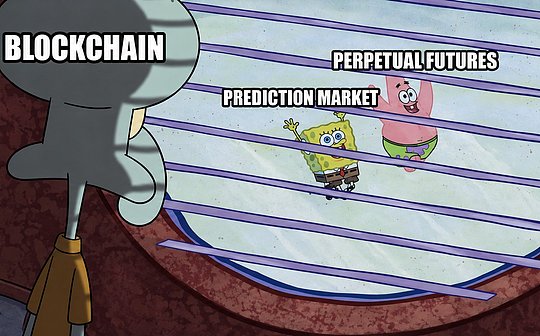
This dichotomy reflects a broader trend. In 2026, the on-chain ecosystem is increasingly polarized. Native DeFi sectors are underperforming, while growth is concentrated in two extremes: speculative products (prediction markets, perps, memecoins) and TradFi bridges (stablecoins, RWA, vaults). Both extremes share a common trait: they use blockchain primarily as financial plumbing.
Prediction markets and perps don’t inherently need blockchain; it provides on/off-ramps and tradable asset utility. Memecoins leverage blockchain for easy token issuance and trading. Stablecoins and RWA use blockchain as a modern backend, replacing outdated infrastructure. This plumbing is valuable—a 24/7 global financial backend is a massive improvement—but the core business logic lies elsewhere. Blockchain is a feature, not the product.
Where Does Value Accrue?
As argued in the recent essay The Commanding Heights, value historically accrues where technology is distributed, not where it originates. In crypto, platforms that own user relationships capture most of the value, while the underlying blockchain remains a commodity. The industry has found product-market fit as financial plumbing, but value hasn’t flowed back to the on-chain ecosystem.
To grow beyond this role, crypto needs businesses where blockchain is indispensable—not just supportive. Many projects have attempted this, but few survive. If blockchain’s utility remains confined to being next-gen financial infrastructure, the industry may end up as one of many hyper-financialized infrastructure providers. That’s not a bad outcome, but it’s not the revolution many envisioned.
Forward-Looking: The Next Catalyst
The path forward is uncertain. A new category of blockchain-native applications could emerge, solving the core-logic problem. Or the catalyst might come from outside technology—political or social shifts that fundamentally change how people perceive blockchain, revitalizing existing applications. Either way, the industry must keep pushing for blockchain to be the centerpiece, not just the plumbing.