AI Self-Improvement and the Coming Market Disruption
Cointime reports: In his latest quarterly investor letter, Leopold Aschenbrenner, founder of Situational Awareness LP (SALP), argues that AI is beginning to accelerate its own research and development, setting the stage for a dramatic economic transformation by 2027-2028. The 167-page letter, his fifth since founding the fund, outlines a future where recursive self-improvement (RSI) could compress three years of typical AI progress into a single year.
Key Observations
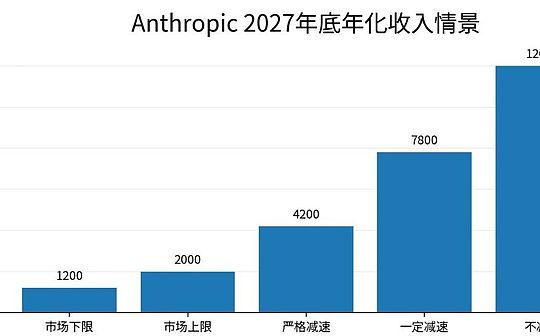
- Divergence in expectations: Financial markets are pricing in a slowdown in AI progress, while Silicon Valley insiders expect acceleration. SALP estimates that market revenue expectations imply AI progress in 2027 will be only 30-60% of historical rates—a view the fund considers overly pessimistic.
- AI-driven R&D: At Anthropic, AI agents already work 19 hours for every human hour, and at OpenAI, agents work 8 times human hours. Anthropic engineers now submit 45 times more code than before 2025. SALP estimates AI-driven acceleration of overall tech progress reached 1.5x by mid-2026 and could hit 2x by year-end.
- Revenue projections: SALP believes combined annualized revenue of OpenAI and Anthropic could exceed $1 trillion by end-2027, driven by AI expanding into broader white-collar work and high-intensity use by a small number of power users.
- Compute value: Rather than becoming cheaper, existing compute may become more valuable as AI capabilities grow, with a single GPU-hour potentially generating hundreds or thousands of dollars in economic value.
Implications and Risks
The letter highlights a shift in the primary risk from technical feasibility to political and regulatory constraints. Aschenbrenner warns that a major safety incident, akin to Three Mile Island, could trigger a public backlash and a moratorium on AI development—a scenario he assigns roughly 10% probability. He also notes that data center construction limits and rising financing costs are unlikely to halt progress, as long as AI investments yield high returns.
Forward Outlook
While SALP acknowledges potential errors in its forecasts, the fund believes the gap between financial market skepticism and technologist optimism cannot persist. If no outright ban occurs, Aschenbrenner suggests that by 2028, the world may see a new era dominated by superintelligent agents, making 2027 possibly the last year that feels relatively normal.