Regulation Reshapes South Korea’s Exchange Listing Structure
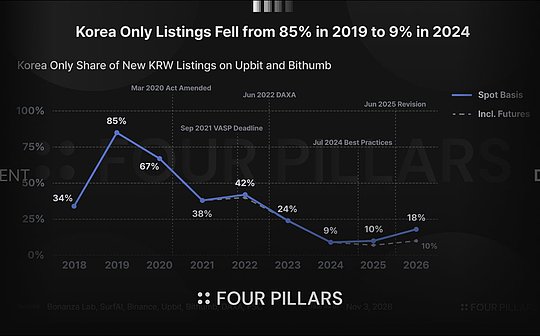
Cointime reports: South Korea’s cryptocurrency exchanges have undergone a fundamental shift in how they list new assets, with regulatory frameworks playing a decisive role in the decline of “Korea-first” listings. The share of new Korean won market listings on Upbit and Bithumb that debuted in Korea before appearing on major global exchanges—Binance, OKX, Bybit, and Coinbase—has plummeted from 85% in 2019 to just 9% in 2024.
The Regulatory Catalyst
The decline coincides with the gradual formation of Korea’s virtual asset regulatory framework. The 2020 amendment to the Act on Reporting and Use of Specific Financial Information (Special Financial Information Act) imposed registration and anti-money laundering (AML) obligations on virtual asset service providers (VASPs), requiring exchanges to complete registration by September 2021. Real-name bank accounts became a legal requirement for won markets, forcing exchanges to adhere to traditional financial AML standards. The impact was immediate: Korea-first listings dropped from 19 per quarter to just 3 in Q3 2021, the quarter of the registration deadline.
In 2022, five won-market exchanges formed the Digital Asset Exchange Alliance (DAXA) to establish unified listing review guidelines, followed by the “Listing Best Practices” effective July 2024. While these practices do not mandate prior overseas listing, they allow assets traded on qualified overseas exchanges for over two years to be considered as having met whitepaper and disclosure requirements.
Listing Volume and Timing
Despite the decline in Korea-first listings, total listing volume has surged. New won-market listings on Upbit and Bithumb grew from 43 in 2022 to 116 in 2023, 125 in 2024, and 238 in 2025. The timing of listings also fluctuates with market conditions. In 2025, when Bitcoin’s Korean won price remained high, 111 assets listed in Korea within 30 days of their overseas debut, accounting for 47% of that year’s total. By 2026, assets with over one year of overseas trading became the largest group at 52 (31%), including assets like CRV and RSR that had traded overseas for over six years.
Improved Stability but New Challenges
The rise of overseas-first listings has improved post-listing stability. The proportion of assets designated with investment warnings or delisted within two years fell from 24% for 2020 listings to 10% for 2024 listings. Among all listings from 2020 to 2024, 44 of 148 Korea-first assets (30%) received investment warnings or delisting notices within two years, compared to just 26 of 279 overseas-first assets (9%).
Price performance also differs. Assets listed in Korea within 30 days of overseas debut saw a median decline of 39% in the 30 days post-listing, while those with over one year of overseas trading declined only 7%.
However, prioritizing overseas trading history presents challenges for exchanges. Long-traded overseas assets generate limited first-day trading volume, impacting fee revenue. While a market recovery could boost listings of recently launched overseas assets, relying solely on a market-dependent listing structure makes it difficult to build a stable business. The real challenge for Korean exchanges now lies in creating new trading demand and revenue streams beyond listings.