Sam Altman Admits Not Taking OpenAI Equity Was a Mistake
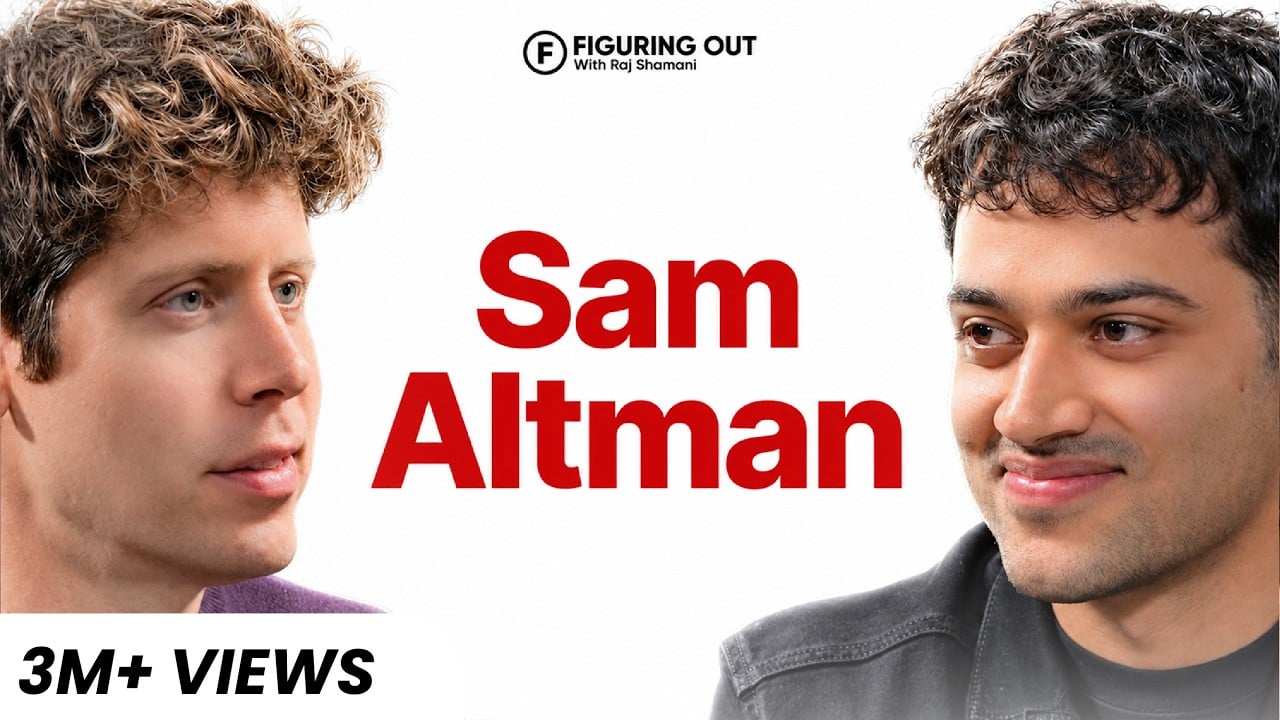
Cointime reports: In a rare and candid interview on the Indian podcast Figuring Out, OpenAI CEO Sam Altman revealed that his decision not to take any equity in the company he co-founded was a practical error, even though his intentions were pure. He explained that the business world struggles to understand such unconventional behavior, leading to public suspicion about hidden motives.
Altman’s confession comes as OpenAI stands at the forefront of the artificial general intelligence (AGI) race, with its technology reshaping industries and sparking intense debate over AI safety, governance, and the concentration of power.
The Scaling Law Bet and the GPT-4 Gamble
Altman attributed much of OpenAI’s success to a core insight: scale yields superlinear returns. This principle, which he observed across Y Combinator startups and neural networks, drove the company to aggressively pursue massive compute. He recounted the pivotal moment in August 2022, after GPT-4 was trained but before its release, when OpenAI bet the entire company on a colossal compute purchase—a move widely seen as reckless at the time. That bet paid off, enabling breakthroughs like chain-of-thought reasoning.
ChatGPT’s Controversial Launch
Another counterintuitive decision was releasing the first ChatGPT despite internal resistance. With a mere 5% retention rate in early testing, most of the team opposed the launch. But Altman, drawing on Y Combinator wisdom, insisted that a small group of passionate users is more valuable than a large group of lukewarm ones. The rest is history: ChatGPT ignited the global AI boom.
Departures and the Superintelligence Dilemma
Altman also addressed the high-profile exits of co-founders and researchers like Ilya Sutskever, Mira Murati, Dario Amodei, and Elon Musk. He described these not as mere conflicts of interest but as a psychological phenomenon: when the stakes involve superintelligence, many brilliant minds believe only they can safely steer the ship. This conviction, combined with differing technical visions, inevitably leads to fractures.
AI’s Next Frontier: Scientific Discovery
Looking ahead, Altman is most excited about AI’s potential to discover new scientific laws. He cited breakthroughs in mathematics and the Navier-Stokes equations as early signs that AI is moving from engineering tool to a engine of scientific discovery. He believes we are closer than expected to a singularity where machines autonomously uncover new physics, cure diseases, and unlock clean energy.
Implications for the Crypto and AI Intersection
Altman’s remarks carry significant weight for the crypto industry, particularly at the intersection of AI and blockchain. As decentralized compute networks and AI agent protocols gain traction, the debate over centralized versus decentralized control of advanced AI becomes more urgent. Altman’s admission that equity misalignment bred public distrust underscores the importance of transparent governance and incentive structures—principles that decentralized AI projects often champion. Moreover, his emphasis on scaling laws and compute concentration highlights the resource-intensive nature of frontier AI, a challenge that decentralized GPU networks aim to address.
As OpenAI continues to push boundaries, the crypto community will watch closely, seeking lessons on how to balance ambition, openness, and trust in the pursuit of transformative technologies.