Microsoft Slows Graduate Hiring as AI Budgets Take Priority
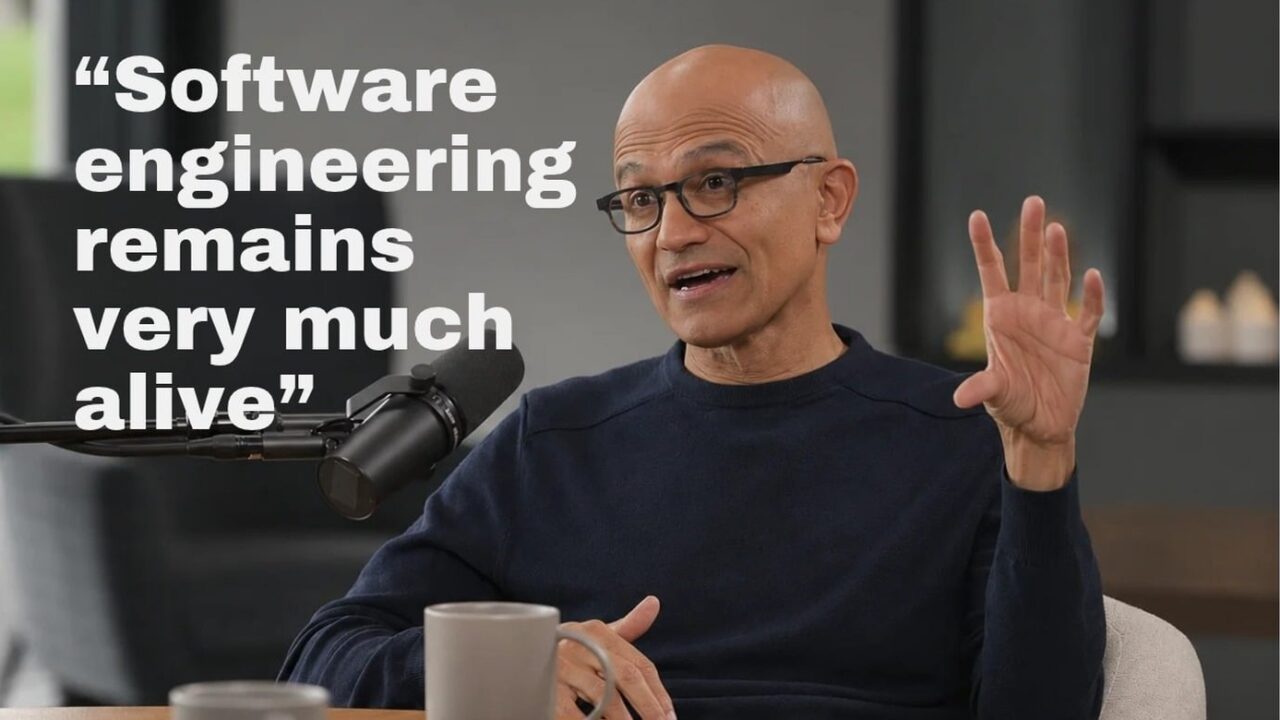
Microsoft CEO Satya Nadella has confirmed that the company has slowed its hiring of new graduates, stating that many companies are doing the same. In a recent podcast interview, Nadella explained that the priority is to ensure all internal staff are in the right positions and to build a “software factory” model where humans and AI share the work of writing software. The second step, he said, is to fully spend the AI budget. He described AI-native companies as starting with an AI budget and one person who maxes out that budget, then asks for another person. “Every company will start to become like this,” he predicted.
This marks a reversal from January, when Nadella said he still strongly believed in campus recruiting because AI acts as a tutor to help newcomers get up to speed faster. Microsoft’s full-time headcount is now about 223,000, down by roughly 5,000 over the year, while revenue grew 18%. It is the first annual decline since 2016. Product R&D saw the largest drop, losing about 3,000 people, and three out of every five net reductions were in R&D roles. In July, Microsoft announced another round of about 4,800 layoffs.
Industry-wide Trend
The trend extends beyond Microsoft. A June report from venture firm SignalFire found that entry-level hiring at 12 major tech companies, including Microsoft and Apple, has fallen about 65% compared to 2019, while overall hiring at these companies is only 25% lower. Shopify CEO Tobi Lütke wrote in an internal memo that teams must explain why AI cannot do the job before requesting more resources. Anthropic CEO Dario Amodei has said AI could eliminate half of entry-level white-collar jobs within five years.
Research supports these warnings. A paper by MIT’s Lindsey Raymond and Microsoft Research’s Eleanor Dillon, using GitHub Copilot data, found that companies adopting the tool hired 29% fewer tech workers per quarter after a year, with junior software engineer hiring down about 40%. A Stanford Digital Economy Lab study using ADP data showed that employment for 22- to 25-year-olds in AI-exposed occupations was about 19% below expected levels as of June.
Structural Shift and Long-term Risks
The structure of work is also changing. Lucy Beaumont of SHL notes that organizations are shifting from a pyramid to a diamond shape, with fewer entry-level workers and more experienced staff in the middle. However, those experienced workers were once trained through entry-level tasks. “AI raises the floor of what a newcomer can produce, but it doesn’t give them the ability to judge where the output is wrong,” said Cheney Hamilton of Bloor Research.
AWS CEO Matt Garman has called the idea of replacing all junior employees with AI “the dumbest thing I’ve ever heard,” warning of a skills gap in ten years. Yet for individual companies, cutting graduate hiring and adding AI budget is a cost-saving move that pays off immediately. If all companies follow this path, the pool of experienced engineers to poach will shrink over time. The long-term bill has not yet hit earnings reports, but the anxiety is already borne by young job seekers and their parents.
Nadella himself cautioned that it is too early to draw long-term conclusions, suggesting the current restructuring phase may be temporary. But his phrase “an AI budget and one person” has already rewritten the career path for new graduates. The question is shifting from whether companies will hire newcomers to where newcomers will become experts.