Circle’s Q3 Earnings: A Tale of Two Businesses
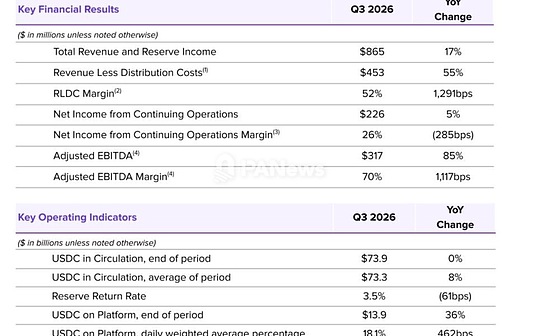
Cointime reports: Circle (CRCL) reported Q3 revenue of $865 million, up 16.9% year-over-year and beating consensus estimates of $778–802 million. However, the headline beat was almost entirely driven by $182 million in presale revenue from the company’s own ARC token. Strip that out, and revenue was roughly $683 million — down about 8% year-over-year.
The ARC token sale, booked under ‘other income,’ carried near-zero cost and accounted for 57% of the company’s $317 million adjusted EBITDA. Excluding ARC, adjusted EBITDA fell to about $135 million, down 21% year-over-year and below Q2’s $143 million. Management’s full-year guidance for other income of $310–330 million implies the remaining three quarters combined will contribute only $103–123 million, signaling the token sale is not a recurring revenue stream.
The Interest Income Squeeze
Circle’s core business remains reserve interest income, which fell 8% year-over-year to $658 million. The company is caught between two opposing forces: average circulating USDC rose 8% to $73.3 billion, adding roughly $57 million in revenue, but the reserve return rate dropped 0.61 percentage points to 3.54%, costing about $110 million. The balance growth cannot offset the rate decline.
On the distribution side, Circle’s net reserve margin — what it keeps after paying channel partners — fell to 37.8%, down 0.8 percentage points quarter-over-quarter. The company attributed the decline to its first full quarter of a revenue-sharing arrangement with Hyperliquid, which one analyst estimates costs Circle nearly $100 million in annual gross profit. A five-year agreement with Binance, which invested $100 million in Circle at $80.84 per share, will also fully impact Q4 results.
Usage Without Monetization
USDC’s on-chain transaction volume hit $13.9 trillion in Q3, up 49% year-over-year, capturing 79% of all stablecoin transaction volume — up from 66%. Yet Circle’s share of stablecoin balances slipped to 27%, down 1.83 percentage points over the year. Each USDC changed hands roughly 190 times during the quarter, but that velocity generates zero direct revenue for Circle. The more a channel uses USDC, the more leverage it has to demand a larger share of interest income.
Circle is attempting to build a toll booth on this highway through its Circle Payments Network (CPN), which reached $41.3 billion in annualized payment volume by quarter-end and over $58 billion by late October. The company also announced a $400 million all-stock acquisition of payment firm Tazapay, which processes over $250 billion in annualized volume. However, CFO Jeremy Fox-Geen stated that CPN will not contribute materially to revenue until 2027.
Looking Ahead
Q4 will offer a cleaner picture: no ARC presale revenue, with Hyperliquid and Binance arrangements fully reflected. Until CPN begins charging fees, Circle’s financials will remain hostage to two variables it cannot control — interest rates and the balance of USDC in circulation. The company’s growing transaction volume is a testament to its utility, but utility alone does not pay the bills.