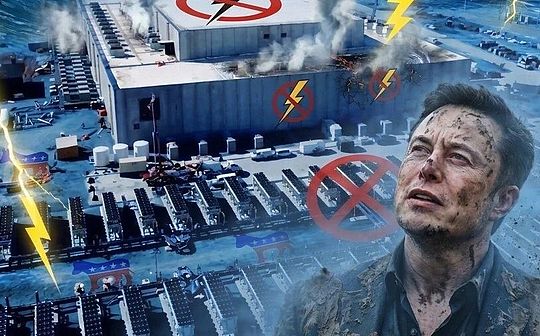
Democratic Sweep Triggers AI Infrastructure Sell-Off as Data Center Expansion Faces Regulatory Hurdles
Cointime reports: In a surprising midterm election outcome, Democrats secured sweeping victories across both chambers of Congress and key statehouses, prompting a sharp divergence in global equity markets. While Chinese A-shares rallied strongly on November 4, with the Shanghai Composite up 2.16% and the ChiNext Index surging 6.40%, U.S. AI infrastructure stocks suffered steep declines. Power producer Vistra Energy fell 13.83%, liquid cooling leader Vertiv dropped 12.89%, and on-site power specialist Bloom Energy lost 6.36%, dragging the Philadelphia Semiconductor Index down over 3%.
Regulatory Fears in Traditional Red States
The sell-off was triggered by Democrats flipping traditionally red states such as Texas, Ohio, and Georgia. Market participants fear that new Democratic governors will impose moratoriums on new data center construction. Texas alone accounts for roughly 25% of planned U.S. data center capacity. Combined with other states likely to tighten regulations, nearly 45% of planned capacity could be affected. Democratic candidates have explicitly advocated for stricter oversight, including removing tax incentives, tightening environmental and water usage rules, and empowering local governments to enact moratoriums.
The political shift has been rapid. Texas Governor Greg Abbott, who initially supported data center growth, recently reversed his stance due to community pressure over resource consumption and environmental impact. This grassroots resistance could stall numerous projects, threatening billions in investment.
Valuation Compression and Earnings Risk
The market reaction has been brutal. The Philadelphia Semiconductor Index now trades at just 12 times forward 24-month blended earnings, below the lows seen during the “Liberation Day” tariff scare and the Iran tensions, approaching 2022 levels. Nvidia trades at only 10 times earnings, its lowest since 2013. This suggests investors are pricing in a peak in 2027 earnings, as capital costs and financing constraints limit expansion.
Industry analysis warns that a one-year delay across multi-gigawatt data center projects could result in up to $100 billion in lost or deferred revenue. A single 300-megawatt data center can generate $1 billion in monthly value, so extended construction timelines mean massive capital tied up and missed revenue opportunities. The real bottleneck is no longer chips or servers but stable, cheap, and massive power supply, along with grid interconnection, transformers, and transmission infrastructure—all of which have longer lead times than hardware.
Winners and Losers
Elon Musk was among the first to feel the pain. Having moved Tesla and SpaceX operations to Texas to escape California’s regulations, and donating nearly $450 million to Republican candidates, Musk saw Tesla and SpaceX shares drop nearly 6% pre-market and SpaceX fall about 8% after the open. He joked on X: “Looks like my election-interfering space lasers didn’t work this time.” He later added: “Building data centers in space now seems quite attractive.”
Goldman Sachs offers a relatively optimistic view, suggesting the impact will be primarily at the state level and may last only months, concentrated in the first half of 2027. New regulations are expected to focus on economic incentives, electricity pricing, and environmental permits, aiming to “regulate” rather than “halt.” At the federal level, substantive data center regulation is unlikely, and permitting reform could emerge as a bipartisan win during the lame-duck session, potentially easing transmission bottlenecks.
For tech stocks, Goldman predicts divergence: hyperscalers with existing capacity, such as Microsoft and Amazon, may benefit from tighter supply and rising value of installed compute, while AI hardware suppliers face continued pressure. The deeper question is how AI labs like Anthropic and OpenAI will secure affordable compute. Anthropic’s latest prospectus reveals approximately $5 billion in compute from expensive short-term purchases in Q3, likely from SpaceX’s AI business. If Texas construction slows, short-term compute will only become more expensive and harder to obtain, potentially slowing AI adoption and impacting the entire ecosystem.