A $3 Trillion Wipeout
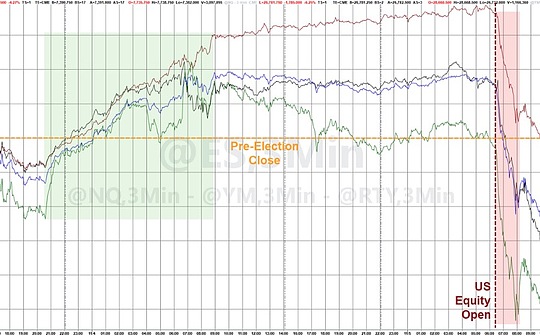
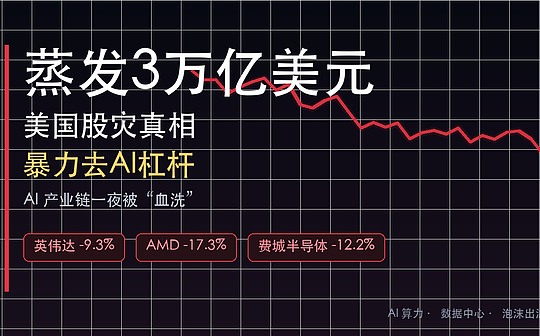
Cointime reports: In a single trading session, the U.S. stock market lost approximately $3 trillion in value, with the AI supply chain at the epicenter. The Nasdaq Composite plunged 5.52%, Nvidia fell 9.3%, AMD crashed 17.3%, and the Philadelphia Semiconductor Index dropped 12.2%. Even SpaceX, a private company, saw its valuation marked down by 9%. The rout extended to Anthropic, whose planned IPO now faces a dramatically lower valuation—potentially slashed from $1.8 trillion to $500 billion.
Political Shockwaves
The immediate trigger was the U.S. midterm elections, where Democrats scored major victories, raising fears of restrictive AI policies. In Texas, Georgia, and Ohio, newly elected governors have pledged to pause or conditionally halt new data center construction. Texas alone accounts for roughly a quarter of planned U.S. data center capacity through 2030. With 44 out of 45 local referendums supporting data center restrictions, and Goldman Sachs estimating that 45% of planned capacity could be affected, the market is pricing in significant delays.
Deeper Troubles: Overinvestment and Policy Risk
Beyond election jitters, the selloff reflects deeper concerns about overheated AI spending and insufficient commercial returns. Five major tech companies are projected to spend over $400 billion in capital expenditures in 2025, with a further 75% increase expected in 2026. Meanwhile, some lawmakers are pushing to pause advanced AI development altogether. Representative Yassamin Ansari has proposed the “2026 Ban on Artificial Superintelligence Act,” which would impose a moratorium on AI systems trained with compute exceeding 10^25 operations, with penalties of up to 20 years in prison for violations. While not yet law, it signals a new front of policy risk.
Funding Environment Deteriorates
The IPO market is already feeling the chill. Anthropic’s roadshow, originally slated for the week of November 9, is now in question as investors demand steeper discounts. Other AI-related listings, including Firmus (backed by Nvidia), AirTrunk (Blackstone), and SB Energy (SoftBank), have been withdrawn or postponed. For smaller AI startups with distant profitability, the era of easy money may be over.
What’s Next: A Necessary Correction?
Some investors view the selloff as a violent deleveraging rather than a fundamental reversal. “The 10-20 year AI cycle is still in its early innings, but the 1-3 year investment boom is entering a clearing phase,” said one long-term tech investor. Others see a bifurcation: some will continue to chase breakthrough technologies, while others will focus on near-term profitability. As the easy money retreats, the AI sector may face a wave of consolidation—and a necessary shakeout.