Nasdaq’s 4-Sigma Plunge: AI Fears and Blue Wave Jitters Amplified by Forced Selling
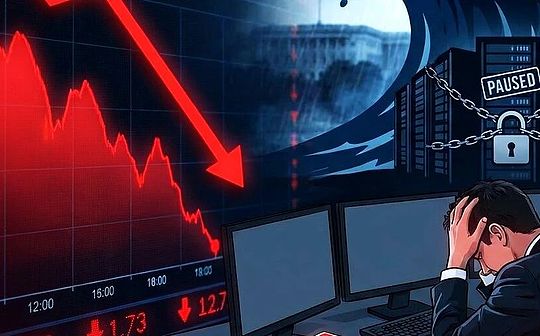
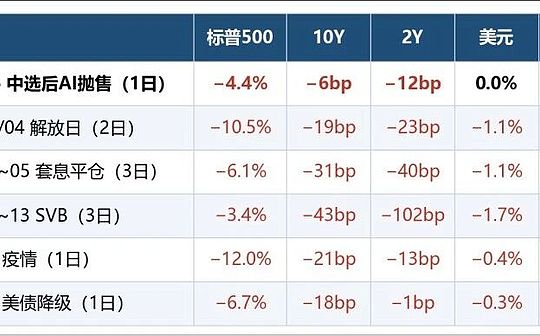
Cointime reports: On November 5, the Nasdaq Composite fell 5.5% and the S&P 500 dropped 4.4%, marking the largest single-day declines since April 4, 2025. Measured by 250-day volatility, the Nasdaq move was a -4.8 standard deviation event, while the S&P 500 was -5.5 standard deviations. The Philadelphia Semiconductor Index plunged 12%, its second-worst one-day drop on record.
AI Concerns and Political Uncertainty
The sell-off was rooted in growing pessimism over AI financing costs and revenue prospects. Goldman Sachs prime brokerage data shows hedge funds erased all net purchases of AI stocks made since the start of 2025 within five trading days from October 8 to 14, selling about $20 billion of tech shares over two weeks. On October 22, Goldman’s hedge fund VIP basket fell 4.2%, its worst day since 2011.
A catalyst was rising concern over a “blue wave” at state and local levels. Although most market participants understand a national data center moratorium is unlikely to pass, fears are mounting that state and local governments will restrict data center construction. In the midterms, voters supported some degree of restriction in more than 40 data center-related local referendums.
Forced Selling Amplifies the Drop
Fund flows were likely the main amplifier. Trading desks reported broad selling by hedge funds, leveraged ETFs, CTAs and retail investors. Nomura estimated that leveraged and inverse ETFs needed to sell about $47 billion of stocks before the close, the second-largest since data began in 2006, mainly from triple-leveraged tech and AI products. Retail investors, typically buyers of dips, sold $338 million of individual stocks in the final hour, the largest single-day outflow since March 2020.
Rumors of hedge fund liquidations added to the anxiety. Walleye Capital told investors it lost 5.9% in October, its worst since March 2020, and is cutting its internal equity long-short team and returning capital—a proactive contraction, not a forced liquidation. Losses among multi-strategy pods are widespread: Millennium fell 2.3% in October and Marshall Wace’s Eureka dropped 5.4%.
Not a Recession Trade
Cross-asset moves suggest this is not yet a recession or panic trade. The 10-year Treasury yield fell 6 basis points to 4.84%, and the 2-year dropped 12 basis points—far less than during the 2023 SVB collapse or the 2024 carry trade unwind. High-yield spreads widened only 7 basis points. The dollar was flat, the yen rose 0.5%, and gold gained 0.7%, indicating no broad flight to safety or margin-call driven selling of safe assets.
Historically, after 4-sigma single-day declines, the Nasdaq tends to bottom out in the short term. Since 1972, there have been 28 such events. The median return 5 and 10 days later was -1.0% and -1.6%, respectively, with only 30% of cases positive. Over 3, 6 and 12 months, median returns were +2.1%, +4.8% and +11.3%. When no recession followed, the index recovered its losses within three months in cases such as October 1997, August 1998, August 2011, August 2015, February 2018 and April 2025.
Implications for Crypto Markets
For crypto investors, the key takeaway is that this is an equity-specific shock rather than a systemic liquidity event. Crypto has become increasingly correlated with tech stocks, so short-term volatility may persist. However, the absence of cross-asset contagion and the historical pattern of recovery in non-recession scenarios suggest that any crypto sell-off driven by this event could be a buying opportunity, provided the macro backdrop remains stable.